
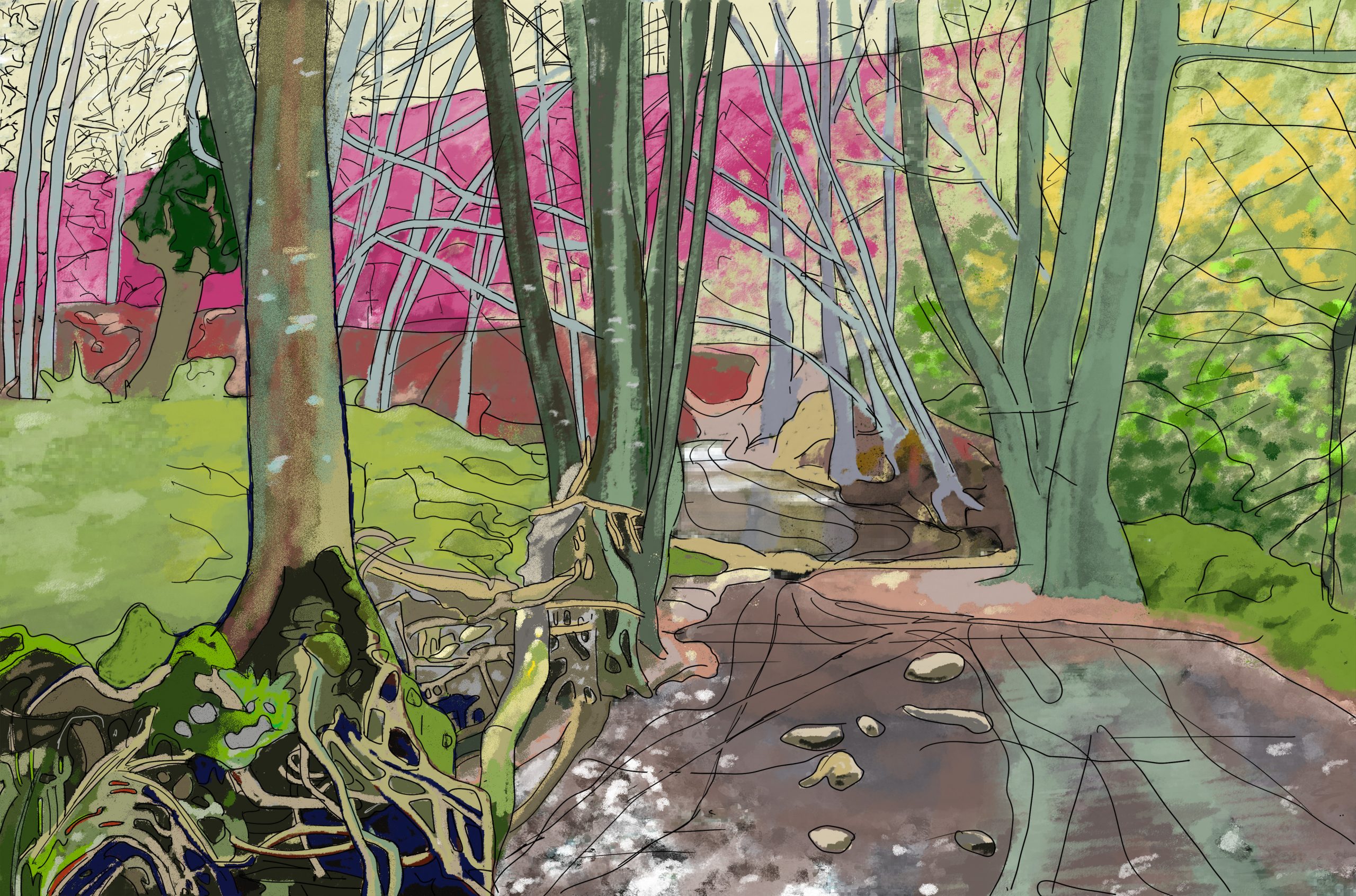
Whilst it was not part of my brief, I saw the creative potential in the view of the Dulas Brook that runs through Ewyas Harold, which I found on the Herefordshire Wildlife Trust website. I had walked on Ewyas Harold Common and knew that it was renowned for its proliferation of wild butterflies. This piece of work allowed me to develop the techniques that I had discovered in previous work, in particular Nupend Wood, the first painting that I had done for this project.
The vertical components, mainly trees, give a feeling of height, whilst the colour pallet creates an impression of depth. The magenta works well against the greens to induce vibrancy. Once again I have been able to use the water to good effect by using it to capture reflections, and an area of interest. The tangled roots in the foreground provide a counterpoint against the more abstract background.
The overall composition is balanced and contains sufficient elements to hold the attention of the viewer. It is easy to visualise being in that space in real life.
The Parks – background information from Herefordshire Wildlife Trust
The Parks lies midway along the Dulas Brook valley and comprises an impressive and majestic sweep of grassland lying on the gentle north and south facing slopes of the brook. Together with the ancient boundary hedgerows, the brook and its wooded margins and scattered parkland trees, the 44 acres of mainly unimproved grassland support a rich diversity of species.
The Dulas Brook that forms the heart of this painting supports a rich diversity of species indicating good water quality. Signs of otters may be seen along its entire length. The brook is also home to two of the otter’s favourite prey items: eels and native white-clawed crayfish. Our native crayfish have suffered a serious decline during the last decade, mainly due to competition from, and a fungal disease carried by, introduced non-native crayfish. Among the bird species present along the brook dipper, grey wagtail and kingfisher are notable. The margins of the brook support a rich bryophyte flora as well as species associated with woodland and river margins such as bluebell, primrose, wood anemone, figwort, brooklime, angelica, meadowsweet and opposite-leaved golden saxifrage. Beautiful demoiselle damselflies are prolific in late spring and summer.
The margins of the brook are being managed under a long-term coppicing regime so that there is a good age range of trees, including veterans, present.
Recent Comments